
 Skip to Content
The Comstock Lode, found near Virginia City in 1859, produced almost 7 million tons of milled ore by 1880. This page gives the figures where sources agree, and a range where they differ.
Checked November 2, 2026. Dates, prices and hours change; the official page wins.
- 1859silver strike near Virginia City (NPS)
- 7M tonsore milled, 1860-1880 (NPS)
- $700Mprofit in today’s dollars (NPS)
- 1881lode exhausted per NPS
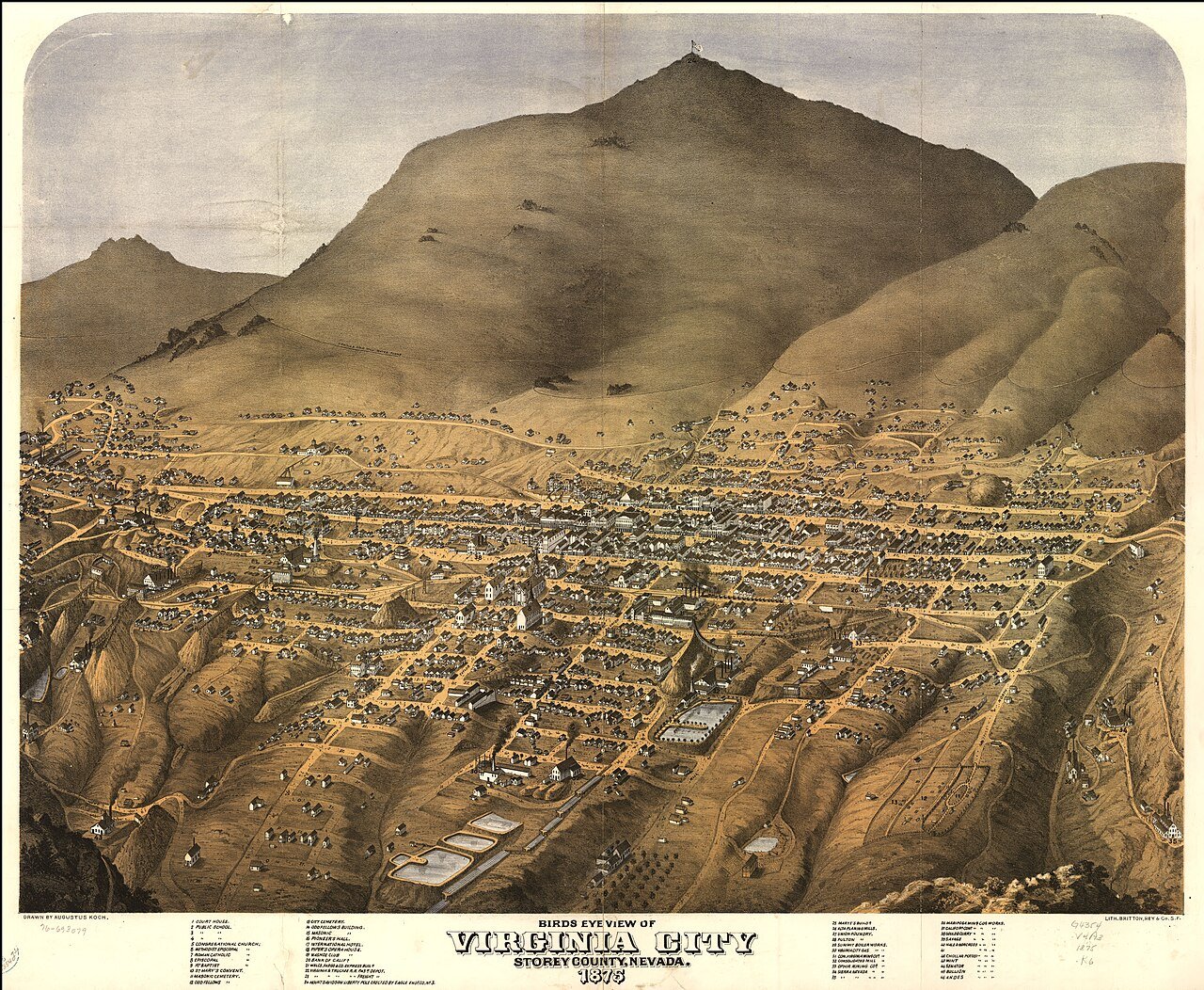
Discovery, 1859
The National Park Service says that in 1859 miners made silver and gold strikes near Virginia City, the first major silver strike in the United States. The Virginia City Tourism Commission names Henry Comstock, part-owner of the ground where it was found, as the man credited with the June 1859 discovery of the rich ore, and says he was nicknamed “Pancake” for the only breakfast he made. He was one of the original finders of gold in Gold Canyon, just south of town.
Who found what, and when, is argued. Wikipedia (a secondary source) credits the Grosh brothers with an earlier find in 1857, four Gold Hill miners with a January 1859 outcrop and two other prospectors with the Ophir deposit that spring. We do not rank those claims; the Nevada State Museum or the Comstock History Center in Virginia City can.
The Numbers, With Their Sources
| Figure | What the source says | Source | Note |
|---|---|---|---|
| Ore milled, 1860 to 1880 | Almost 7 million tons | NPS | Rounded by the park service. |
| Profit, same years | About $700 million in today’s money | NPS | A modern-dollar estimate, not a 1870s total. |
| The “Big Bonanza,” 1873 | At least $300 million from the Ophir, Gould & Curry and Consolidated Virginia mines | Virginia City Tourism Commission | Counted in 1870s dollars. |
| All production, 1859 to 1878 | $320 million, with $55 million net profit | Wikipedia (secondary) | Different years and a different measure than the two rows above. |
| Chollar Mine alone | About $17 million over roughly 80 years | Chollar Mine Tour | One mine; see the Chollar page. |
The figures use different years and different dollars, so they do not add up or cancel out. Treat them as a range, from the hundreds of millions in period dollars to about $700 million in today’s.
How Many People Lived Here
The park service puts Virginia City and Gold Hill at about 4,000 people in 1862 and about 25,000 by 1874. At the peak it counts 25 theaters, five police precincts, several newspapers and more than 100 saloons, and says Virginia City had the first miners’ union in the country. Census counts run lower than that peak guess: Wikipedia lists 7,048 in 1870 and 10,917 in 1880 for Virginia City. The 25,000 is an estimate, not a head count.
Chinese workers dug the Rose Ditch in 1855, and the camp at the mouth of Gold Canyon that grew into Dayton became the processing and freight hub for Comstock ore, the park service says. By the 1870s Virginia City’s Chinatown held 1,500 to 2,000 people at a time.
Underground
The Tourism Commission says miners worked in shafts and tunnels about 3,000 feet beneath the town, where it reached about 100 degrees. Timber was the problem: soft ground caved in. Wikipedia (secondary) credits German engineer Philip Deidesheimer with inventing square-set timbering at the Ophir Mine in 1860, a frame of heavy timber cubes set as ore was taken out, which he did not patent. The Chollar Mine tour shows square-set timbering, silver ore and rock drills on its own page. The 1860 date and the inventor are not on any museum page we read.
Water was the other problem. See the Sutro Tunnel.
The Slide and The Fire
By the mid-1870s the lode was seen as played out, the park service says: ore in two big mines was overestimated, the Bank of California failed, San Francisco’s stock market crashed in 1875 and a great fire hit the town. A fire that began October 26, 1875 left about 8,000 people homeless and cost an estimated $10 million, the Tourism Commission says, and most of the town was rebuilt in less than a year, including the six-story International Hotel with Nevada’s first elevator. (The park service page gives the fire year as 1876 in one place and 1875 in another; we use 1875.) When a rich lode turned up at Bodie, California in 1878 many people left. By 1881 the Comstock was exhausted, with ore output at a 20-year low, and mining after that stayed small.
One mine fire is counted two ways. Wikipedia gives the April 1869 Yellow Jacket fire as killing at least 35 in one article and 37 in another.
On The Map
What We Could Not Confirm
These items were not read on an official page when we checked, so we do not state them as fact. Who can confirm each one is named.
- Per-mine production for Ophir, Gould & Curry and Consolidated Virginia (Nevada State Museum or the Comstock History Center).
- Who first found the lode, and the square-set timbering date (Nevada State Museum).
- The Virginia City National Historic Landmark designation year: Wikipedia says 1961; the park service page we read does not give it (NPS).
- The Yellow Jacket fire death toll, 35 or 37 (Nevada State Museum).
More to Explore
- Virginia City And The Comstock
- The Sutro Tunnel
- Chollar Mine
- Mark Twain And The Territorial Enterprise
Frequently Asked Questions
How much silver did the Comstock produce?
The sources we read give profit and total value, not silver alone. NPS: almost 7 million tons milled 1860-1880, about $700 million in today’s dollars. Silver and gold are not split out on any page we read.
Who discovered the Comstock Lode?
Henry Comstock is credited on the Tourism Commission page; other accounts name earlier prospectors. It is disputed.
Sources
- National Park Service: Virginia City Historic District (official)
- Virginia City Tourism Commission (official)
- Nevada State Historic Preservation Office: Comstock Lode marker
- Chollar Mine Tour (official)
- Wikipedia: Comstock Lode (secondary)
- Wikipedia: Philip Deidesheimer (secondary)
Cite this page: It’s Reno editorial team, “The Comstock Lode,” itsreno.com, checked November 2, 2026.