
 Skip to Content
People around Reno and Tahoe ask most about black bears, coyotes, mountain lions, the wild horses of the Virginia Range, bald eagles and the kokanee salmon at Taylor Creek. Every row here comes from an agency page we read, and a range is never presented as a sighting.
Checked November 3, 2026. Dates, prices and hours change; the official page wins.
- 4grouped tables of animals
- 775-688-BEARNDOW bear hotline
- Oct-Novkokanee run at Taylor Creek (USFS 2026)
- Nov 3, 2026sources last read
Big and Hoofed Animals
NDOW’s species pages list Nevada counties without saying what the list means. Where that is all a source gives, the row says range only, because a range is not a sighting.
| Animal | Where and when per the source | Safety note | Source |
|---|---|---|---|
| Mule deer | NDOW lists mule deer statewide, from Sierra conifer forest to sagebrush. Does have two fawns in early summer and leave them alone for hours. Range only; local sightings not confirmed. | NDOW’s mountain lion guide says not to feed deer. Leave a lone fawn alone. | NDOW mule deer |
| Elk | NDOW lists habitats of prairie, forest, sagebrush and mountain meadow and a county list that includes Washoe, Douglas and Carson City. Range only; local sightings not confirmed. Not confirmed near Reno or Tahoe. | Calves lie still and hidden while the mother feeds; NDOW says to leave a lone calf alone. | NDOW elk |
| Pronghorn | NDOW places them mainly in the mountain ranges of northern and central Nevada, in open sagebrush and grassland; rut is early fall. Range only; local sightings not confirmed. | The page gives no safety advice. | NDOW pronghorn |
| California bighorn sheep | NDOW describes slopes of the Sierra Nevada, alpine, cliffs, canyons and desert washes, with seasonal range shifts and a fall rut. Range only; local sightings not confirmed. | The page gives no safety advice. | NDOW bighorn |
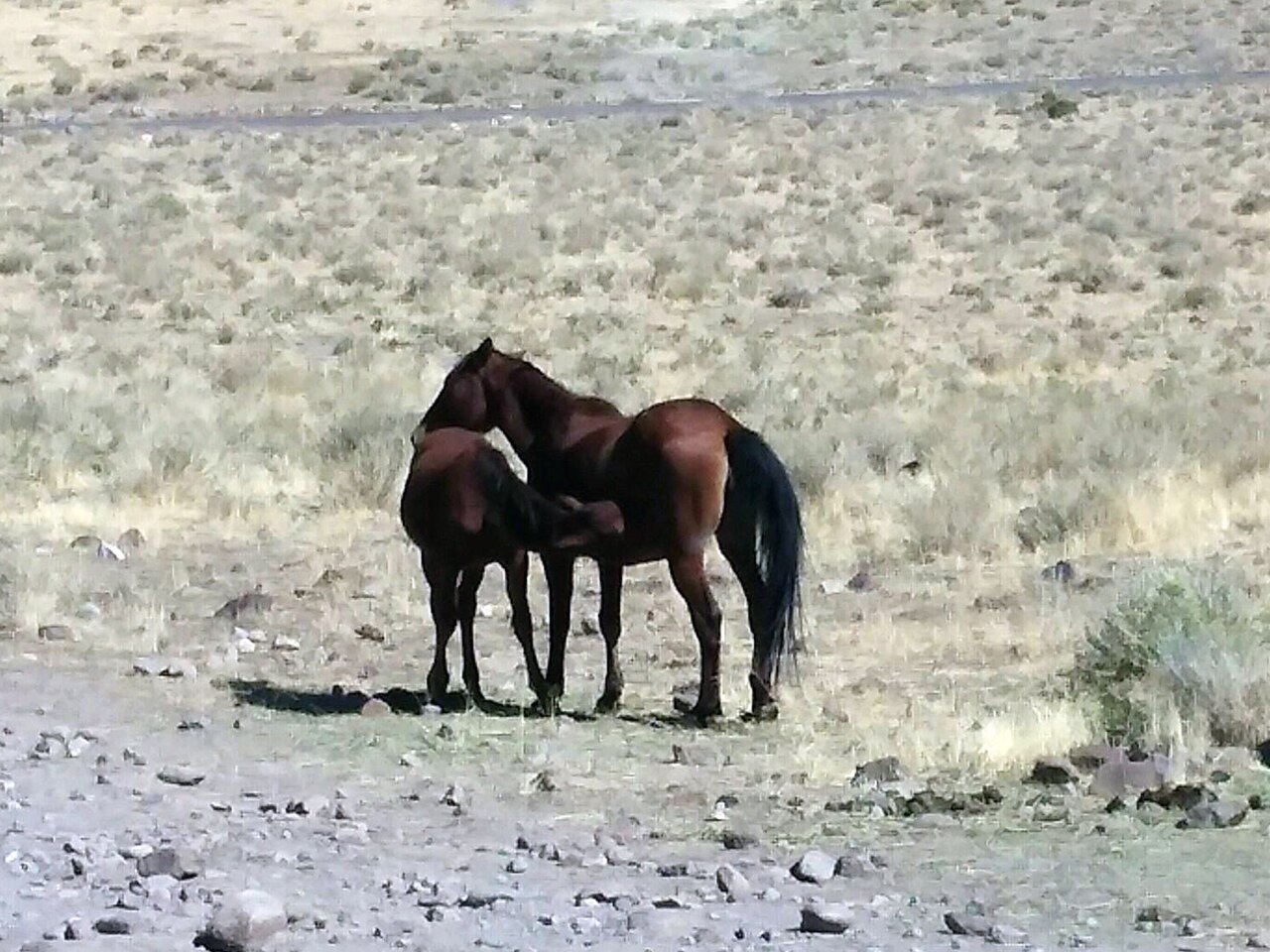
| Wild horses of the Virginia Range | The Nevada Department of Agriculture describes the range as Highway 395 to 95A and I-80 to Highway 50 (2019 news item). Horses wander onto roads and into neighborhoods. | The department says horses should not be fed or harassed and that this is illegal; slow down, especially after dark. The fine and statute are not confirmed. | Nevada Dept. of Agriculture (2019) |
| Black bear | NDOW places black bears in the mountains and foothills of the Sierra Nevada and the Lake Tahoe area. They feed heavily in fall and usually hibernate in winter, but may stay active in mild winters or when food is abundant. | Secure trash, never feed, keep food out of vehicles, back away slowly; see Staying Safe below. | NDOW black bear; Tahoe BEARS |
| Mountain lion | NDOW lists cold desert shrub, sagebrush, grassland and upland forest, often pinyon, juniper and mahogany. Range only; local sightings not confirmed. | NDOW says encounters are very rare; do not approach or run, back away slowly, and report residential sightings to NDOW dispatch, 775-688-1331. | NDOW mountain lion; NDOW living with lions |
Bears, Cats, Coyotes, Foxes and Small Mammals
| Animal | Where and when per the source | Safety note | Source |
|---|---|---|---|
| Coyote | NDOW calls coyotes common in wild and urban areas, in cold desert shrub, developed areas and upland forest; pups follow breeding in January to March. | Remove attractants, keep dogs on a 6-foot leash and supervise at dawn and dusk, keep cats indoors, and haze sightings by standing tall and yelling (NDOW). | NDOW coyote; NDOW living with coyotes |
| Bobcat | NDOW places bobcats in rocky areas with prey and cover; they may turn up near homes, mostly at night but also at dusk and by day. Range only; local sightings not confirmed. | The page gives no safety advice. | NDOW bobcat |
| Red fox | NDOW says red foxes are expanding in Nevada and are most common in the west of the state, in open woodland, mountain meadows near treeline and shrubland. | The page gives no safety advice. The CDC lists foxes among the animals that most often carry rabies in the US. | NDOW red fox; CDC rabies |
| Gray fox | NDOW lists grassland, upland forest and riparian areas; mostly active at dusk and night; climbs trees. Range only; local sightings not confirmed. | The page gives no safety advice. Foxes are on the CDC rabies-carrier list. | NDOW gray fox |
| American badger | NDOW says statewide, in farmland, grassland and Sierra alpine forest; nocturnal, burrows by day, solitary. | The page gives no safety advice. | NDOW badger |
| Raccoon | NDOW says all 17 counties; nocturnal, in forests near water, streams, farms and cities, and eats from residential trash. | NDOW says not to feed raccoons or leave food or trash out. The CDC lists raccoons as rabies carriers. | NDOW raccoon; CDC rabies |
| Striped skunk | NDOW lists agriculture, playas and developed areas; breeding about February to April. | A stomp, arched back and raised tail come before spray (NDOW). The CDC lists skunks as rabies carriers. | NDOW striped skunk |
| North American river otter | NDOW lists lakes, marshes and slow rivers; breeding late winter to early spring. Range only; local sightings not confirmed. | The page gives no safety advice. | NDOW river otter |
| Black-tailed jackrabbit | NDOW lists arid scrub, farmland and open prairie; mostly active at night, resting under bushes by day. | The page gives no safety advice. | NDOW jackrabbit |
| Desert cottontail | NDOW says widespread statewide in sagebrush, grassland, riparian areas and pinyon-juniper; active early morning, late afternoon and night. | The page gives no safety advice. | NDOW cottontail |
| Marmot | NDOW’s marmot page lists Sierra alpine forest and a hibernation of about September to May depending on elevation. Range only; local sightings not confirmed. The species named on the page was not clear to us. | The page gives no safety advice. | NDOW marmot page |
Birds
| Animal | Where and when per the source | Safety note | Source |
|---|---|---|---|
| Bald eagle | NDOW says bald eagles are in Nevada statewide in winter and breed in only a few areas, near Lake Tahoe and the Colorado River; lakes, reservoirs and rivers. We do not publish nest locations. | The page gives no disturbance guidance. | NDOW bald eagle |
| Golden eagle | NDOW says statewide in open hilly and mountainous country; a state priority species. Seasonal timing is not on the page. | The page gives no safety advice. | NDOW golden eagle |
| Osprey | NDOW says statewide, especially in migration, with breeding pairs concentrated in western Nevada; lakes, reservoirs and rivers; fish make up 99 percent of the diet. | State protected. The page gives no safety advice. | NDOW osprey |
| Greater sage-grouse | NDOW lists sagebrush steppe and cold desert shrubland. Range only; local sightings not confirmed. We do not publish display-ground locations. | The page gives no safety advice. | NDOW sage-grouse |
| Canada goose | NDOW lists agricultural and developed landscapes; goslings imprint and may follow people. | State protected and a game species; the page gives no safety advice. | NDOW Canada goose |
Fish and Reptiles
| Animal | Where and when per the source | Safety note | Source |
|---|---|---|---|
| Lahontan cutthroat trout | The U.S. Fish and Wildlife Service says the fish is native to the Lahontan Basin and historically migrated about 120 miles between Pyramid Lake and Lake Tahoe. NDOW lists it as a state threatened and priority species and a game fish. | Fishing rules are not on either page; check the NDOW regulations before fishing. | USFWS; NDOW Lahontan cutthroat |
| Kokanee salmon | NDOW says Lake Tahoe and its tributaries, spawning in fall. The Forest Service said the 2026 run at Taylor Creek starts upstream in mid-to-late October into November, and that spawning can run as late as February. | The Forest Service says bears and other wildlife are drawn to spawning fish; stay alert, and expect busier roads and parking. | USFS Lake Tahoe Basin release; Taylor Creek Visitor Center |
| Lake trout (mackinaw) | NDOW says Lake Tahoe, in deep cold water, reported as deep as 1,400 feet; fall spawn over rock; a game fish. | Fishing rules are not on the page. | NDOW lake trout |
| Great Basin rattlesnake | NDOW places it in northern Nevada in grassy, shrubby and rocky areas, sagebrush, washes and pinyon-juniper, and says it is easily mistaken for a gopher snake. Range only; local sightings not confirmed. | The page says the snake is venomous and gives no first-aid advice. NDOW’s rattlesnake safety page did not load for us. | NDOW rattlesnake |
Where to Watch
The one place an official statement points to is Taylor Creek on the south shore of Lake Tahoe, where the U.S. Forest Service runs the Taylor Creek Visitor Center and says the kokanee run draws crowds, bears and other wildlife. That release gave 2026 visitor center days and an end-of-season date that has now passed. Read the Forest Service page for current hours.
Staying Safe
- BearsNDOW says unsecured trash is the top attractant, and that Washoe County, Douglas County and Carson City have rules to secure garbage. Use bear-resistant containers, put trash out only on pickup day, keep pet food indoors and food out of vehicles, and lock doors and windows. Report bear trouble to the NDOW hotline, 775-688-BEAR (2327). NDOW.
- Tahoe BasinTahoe BEARS asks for bear-resistant cans at home and bear lockers at campsites, no feeding of any wildlife, clean campsites, and distance from bears and cubs. Tahoe BEARS. The Forest Service says bear canisters are required for overnight stays in Desolation Wilderness and bear-resistant containers elsewhere. LTBMU.
- On the California sideThe California Department of Fish and Wildlife says feeding big game mammals is prohibited there (as its page states Title 14 CCR 251.3). Make noise on trails, leash pets, and back away slowly without running. CDFW.
- Bear sprayThe National Park Service says to use an EPA-approved bear product only on a charging or attacking bear. NPS.
- Mountain lionsRemove deer attractants, supervise kids and pets, avoid dawn and dusk outdoors, and if you meet one do not run; back away slowly, look larger and fight back if attacked (NDOW). NDOW.
- CoyotesKeep dogs on a 6-foot leash, cats indoors, and haze coyotes. Call 911 or NDOW dispatch, 775-688-1331, after an incident. NDOW.
- Wild horsesDo not feed or harass them; drive slowly after dark. Nevada Dept. of Agriculture, 2019.
- RabiesThe CDC says wash a bite or scratch with soap and water and get medical care fast; keep pet vaccines current; bats, raccoons, skunks and foxes are the animals most often carrying it. CDC.
What We Could Not Confirm
These items were not read on an official page when we checked, so we do not state them as fact. Who can confirm each one is named.
- Local sightings of elk, pronghorn, bighorn sheep, mountain lions, bobcats, gray foxes, sage-grouse and the other “range only” rows (NDOW would need to confirm for Washoe, Storey, Douglas, Carson City or Nevada County).
- The fine and law for feeding Virginia Range horses, and current contact numbers (the Nevada Department of Agriculture page we read dates from 2019; its FAQ would confirm).
- Pikas, porcupines, beavers, Clark’s nutcrackers and great horned owls: the NDOW pages did not load, so they are not listed.
- Sierra newts and the Sierra and Tahoe yellow-legged frogs, other waterbirds, and TRPA wildlife pages were not read.
- Rattlesnake bite and avoidance advice (NDOW’s page did not load) and whether hantavirus guidance applies around Reno and Tahoe (the CDC page does not say). We state no risk level.
- Kokanee at Fallen Leaf Lake: no page we read confirms it.
More to Explore
Frequently Asked Questions
Are there black bears in Lake Tahoe?
Yes. NDOW places black bears in the mountains and foothills of the Sierra Nevada and the Lake Tahoe area, and Tahoe BEARS is a public campaign for the Tahoe Basin. Secure food and trash.
Are the Virginia Range horses wild?
The Nevada Department of Agriculture calls them feral horses and says they should not be fed or harassed. Whether they count as BLM mustangs is not covered by the page we read.
When do the kokanee salmon spawn at Taylor Creek?
The Forest Service said the 2026 run starts upstream in mid-to-late October into November, and spawning can run as late as February depending on cold water and rain flows.
Can I feed deer or other wildlife?
Agencies say not to. NDOW’s lion guide says not to feed deer, Tahoe BEARS says never to feed any wildlife, and CDFW says feeding big game is prohibited in California.
Where does the information on this page come from?
Only from the agency pages listed under Sources, all read on November 3, 2026. Anything else is labeled Not Confirmed.
Sources
- Nevada Department of Wildlife species pages (mule deer, elk, pronghorn, bighorn, black bear, mountain lion, bobcat, coyote, foxes, badger, raccoon, skunk, otter, rabbits, eagles, osprey, sage-grouse, goose, trout, kokanee, rattlesnake)
- NDOW: living with bears
- NDOW: living with mountain lions
- NDOW: living with coyotes
- Tahoe BEARS
- California Department of Fish and Wildlife: black bears
- National Park Service: bear safety
- CDC: about rabies
- Nevada Department of Agriculture: Virginia Range horses (2019)
- U.S. Fish and Wildlife Service: Lahontan cutthroat trout
- U.S. Forest Service Lake Tahoe Basin: kokanee release
- U.S. Forest Service: Taylor Creek Visitor Center
- U.S. Forest Service Lake Tahoe Basin Management Unit
Cite this page: It’s Reno editorial team, “Wildlife Around Reno and Lake Tahoe,” itsreno.com, checked November 3, 2026.